

Documentation Index
Fetch the complete documentation index at: https://docs.safefoundation.org/llms.txt
Use this file to discover all available pages before exploring further.
Safe Guards were introduced in
Safe contracts version 1.3.0.
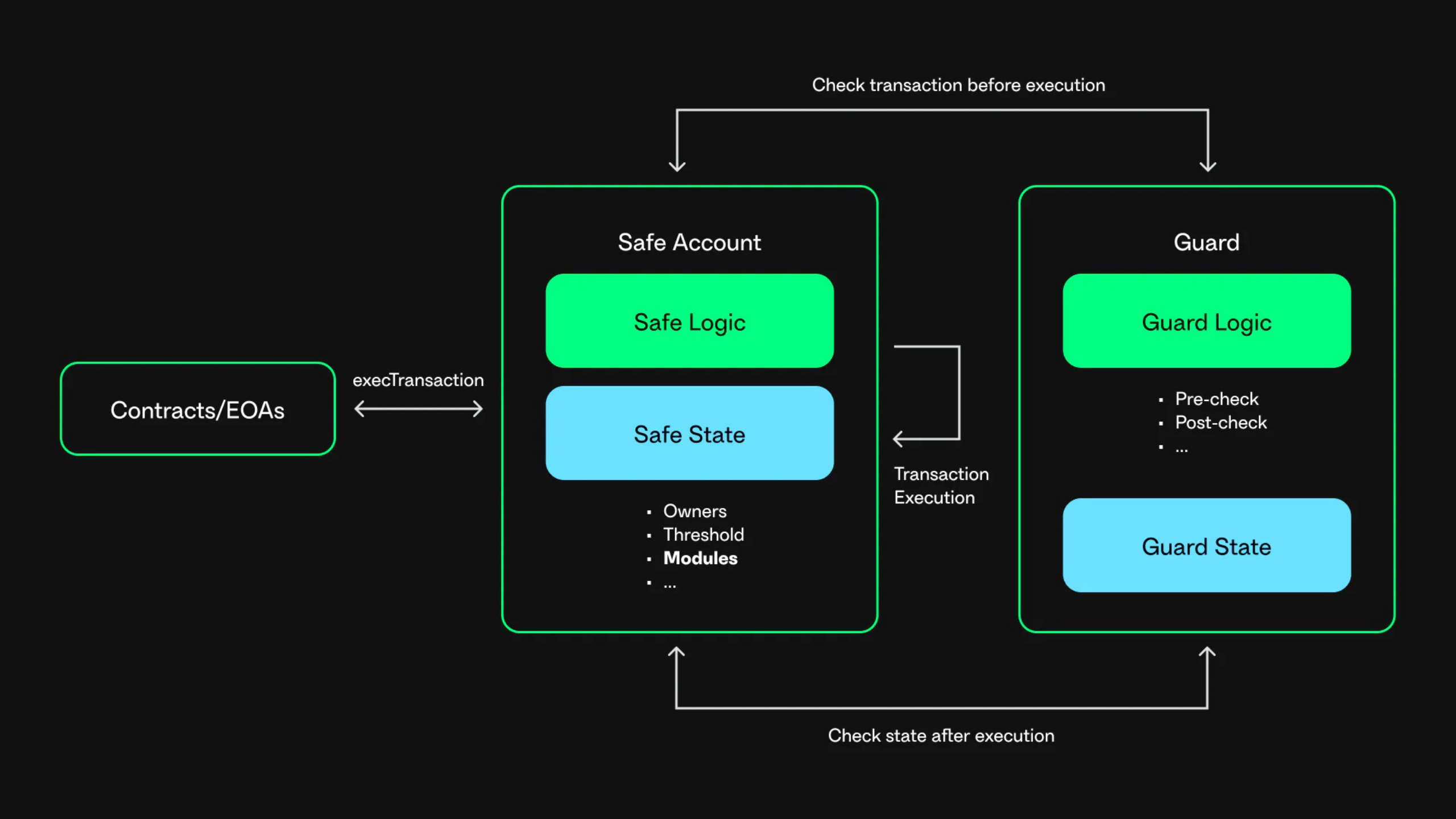
n-out-of-m multi-signature scheme. They allow Safe owners to define custom rules that determine whether a transaction should be allowed to execute.
A Safe Guard can perform checks:
- Before execution, to validate the transaction parameters and context
- After execution, to verify the final state of the Safe once the transaction has completed
Post-execution checks run at the end of the transaction and can be used to assert invariants or detect unexpected state changes. Guards are commonly used to:
- restrict interactions to approved contracts
- enforce protocol-specific invariants
- add additional safety checks around sensitive operations
Important: Safe Guards are security-critical. Because a Guard
can block transaction execution entirely, a faulty or malicious Guard can
cause a denial of service and lock funds in a Safe. Only use well-reviewed and
audited Guards, and always consider recovery mechanisms.